
ROSE PROFILE · FROM MY GARDEN
The Fairy family of roses: pink, red and magenta
Three own-root roses that have proven tough, generous and far more vigorous than I expected.
Around 2019–2020 I planted three kinds of roses from the Fairy family in the garden, from PharmaRosa: pink, red and magenta. After a few years, each bush reached about a meter (3 ft) across.
For me, their strength isn’t a single flower but the overall effect: masses of clusters carried above wide, well-branched bushes. They’ve proven very disease-resistant and remain among the easiest roses to look after in the garden.
Identification note. The pink one is the classic variety The Fairy. Based on its look and the varieties PharmaRosa sells, the red one is probably Fairy Rouge, and the magenta one probably Lovely Fairy.
At a glance
Planted
about 2019–2020
Supplier
PharmaRosa
Roots
own-root, not grafted
Observed size
about 1 m (3 ft) across
Bloom
abundant and repeating
Health for me
very good
The three forms in the garden
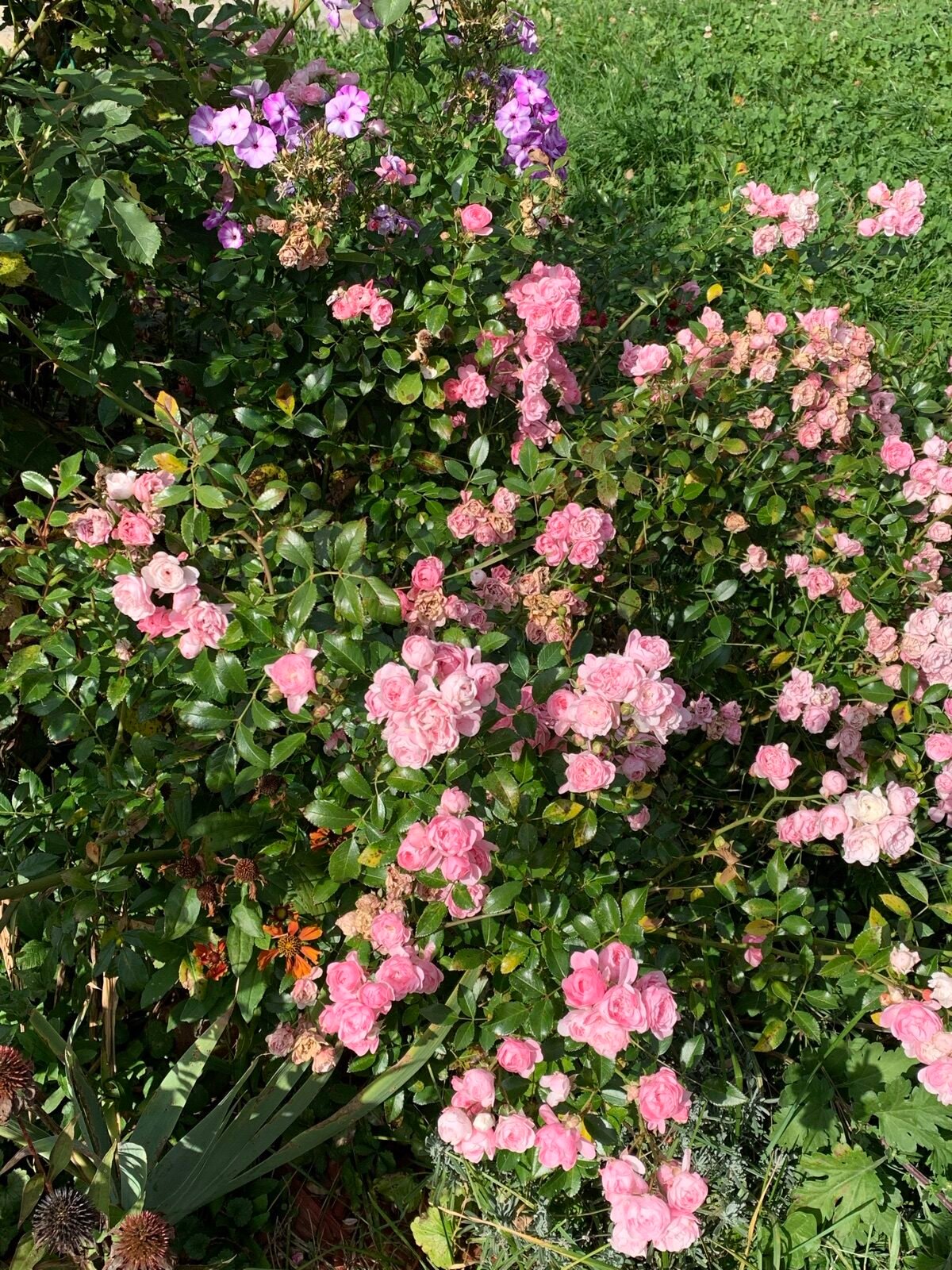
The Fairy — pink
CERTAIN IDENTIFICATION · ANN BENTALL, 1932
The small, double flowers come in generous clusters, in a bright pink that softens as the flower matures. The stems arch and, from a distance, create the effect of a pink cloud.
In my garden: the bush has spread to about a meter (3 ft) and blends in beautifully among perennials.
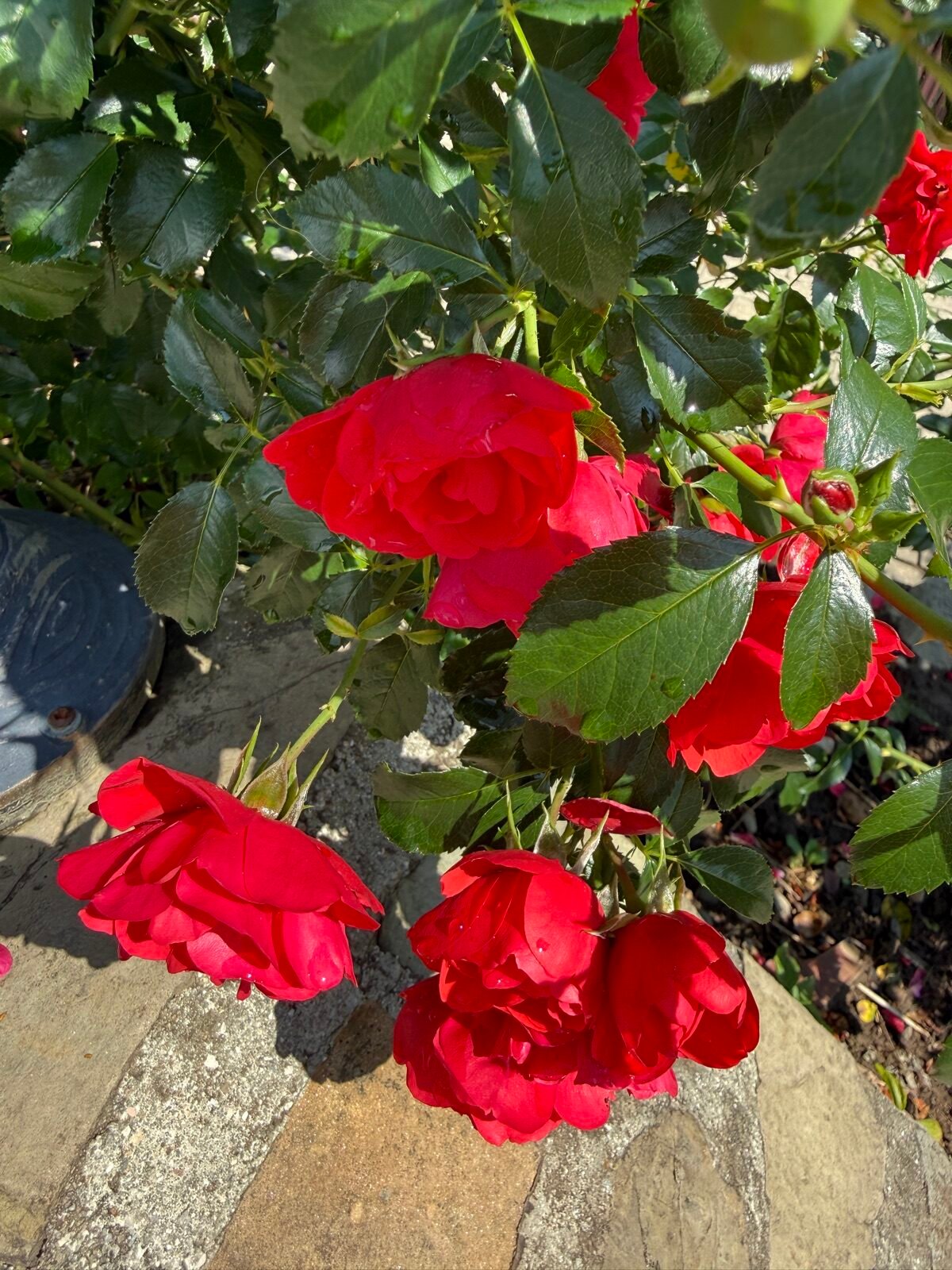
The red form
PROBABLY FAIRY ROUGE · RALPH MOORE, 1995
It has the strongest contrast with the foliage: the very double flowers, in an intense red, form clusters you can see from a distance. Its look matches Fairy Rouge better than Fairy Dance, which has semi-double flowers.
In my garden: it looks best left to form a wide bush, not kept permanently trimmed into a rigid shape.
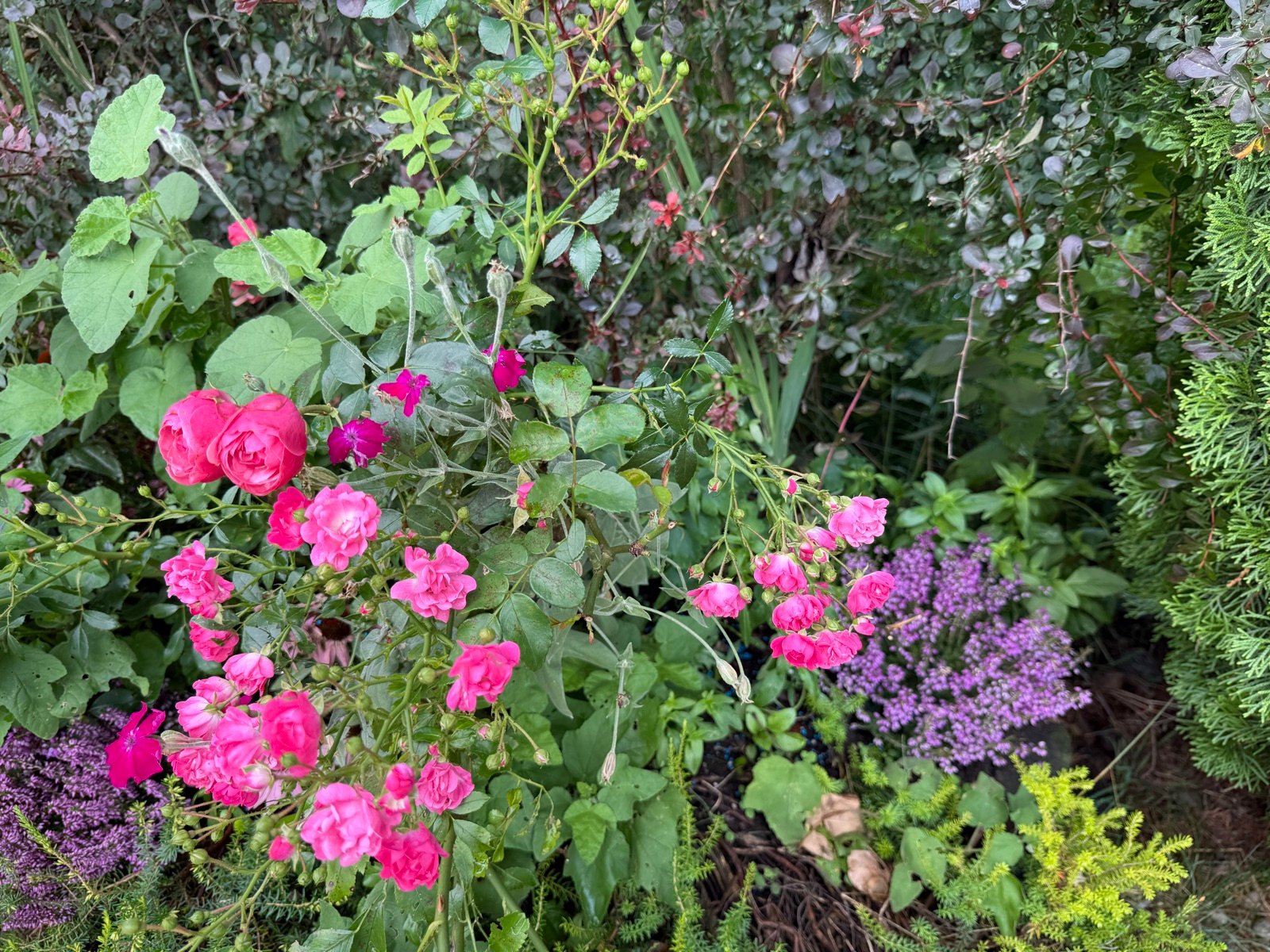
The magenta form
PROBABLY LOVELY FAIRY · SOLD SINCE 1992
The color is cooler and deeper, between deep pink and fuchsia. It keeps the low, spreading habit of the Fairy family and pairs beautifully with mauve, violet, white and silver foliage.
In my garden: the number of flowers and the vibrant color create the effect, without needing very large blooms.
How they’ve done in my garden
After several years, the bushes became much more vigorous than I expected at planting and reached about a meter (3 ft) across. I’d give them enough room from the start, because they can quickly cover small plants set too close.
On health, they were a very pleasant surprise: in my garden’s conditions they had few problems with fungal diseases and kept looking good without complicated measures. That’s an observation from my garden, not a guarantee for every site; light, airflow and soil have a big influence on how a rose behaves.
Because they’re on their own roots, shoots that come from the base belong to the same plant, not to a different rootstock. The bushes thicken up naturally and recover well from the base.
Care
Light and space
They like a bright, airy spot. I leave enough room at the sides so the stems can settle naturally and the foliage can dry after rain.
Soil and watering
They prefer rich but well-drained soil. I water deeply and infrequently, at the base of the bush, especially in dry spells. Compost and mulch help hold in moisture.
Feeding
Moderate feeding when growth starts is enough in most years. I avoid too much nitrogen, which produces soft growth at the expense of flowers.
How I prune them
In spring I start with dead, broken or very thin wood. I remove stems that cross or crowd the center of the bush, then cut back only as much as needed to keep a balanced shape and control the width.
On mature bushes I prefer gradual renewal: I remove a few of the oldest stems at the base rather than cutting the whole plant back hard every year. In summer, removing spent clusters is optional, but it keeps the bush tidy and can speed up the next flush of flowers.
See also the full guide: Pruning roses: when and how I prune them.
Why I keep them
These aren’t roses chosen for a perfect single flower or a strong fragrance. I keep them for their toughness, the continuity of color and the way they tie the plants of a bed together. The pink brings light, the red creates contrast and the magenta adds depth.
Sources and identification
- PharmaRosa – The Fairy
- Royal Horticultural Society – Rosa ‘The Fairy’
- PharmaRosa – Fairy Rouge
- PharmaRosa – Fairy Dance, used to compare flower form
The observations on size, health and how the bushes behave come from my garden in Bran, Brașov County, Romania.