
GARDENING WITH JULIA · PRACTICAL GUIDES
Pests and diseases
Slugs and common rose diseases in a mountain garden
IN THIS GUIDE
I start with the plant and where it grows
Rose downy mildew and misdiagnosis
An observation calendar adapted to the weather
There’s a moment every May when my garden looks perfect. For two weeks. Then comes a week of long rains and cold nights, and they start to show up: black spots on the lower rose leaves, whitish powder on the young shoots, buds rotting before they open and, above all, the silvery trails of slugs that have been working all night.
The text below starts from my experience in my garden in Bran (Brașov County, Romania) and focuses on slugs and a few rose diseases. It isn’t a catalog of every problem in the garden. In cold, wet spells, certain diseases find favorable conditions, but neither altitude nor a spot on a leaf makes the diagnosis on its own.
I start with the plant and where it grows
For many infectious diseases, the meeting of the pathogen, a susceptible plant and favorable conditions explains why an attack happens. This “disease triangle” helps me see where I can step in. But not every yellowing or spot means infection: drought, too much water, cold and unsuitable treatments can also cause damage.
I can’t eliminate every pathogen, but hygiene can reduce local sources of infection. I can choose more resistant varieties and limit plant stress through the right placement, watering and feeding. Airflow and how long leaves stay wet matter, but their effect differs from one disease to another.
First I identify the problem and how widespread it is. I check the variety, the exposure, the spacing, the watering and any diseased debris around. Treatment, if needed, comes after these checks and doesn’t replace them.
My goal isn’t a sterile garden, but one where the damage stays bearable. A few spotted leaves aren’t an emergency. But repeated, severe leaf loss can weaken the plant and reduce its ability to get through winter well.
Snails and slugs
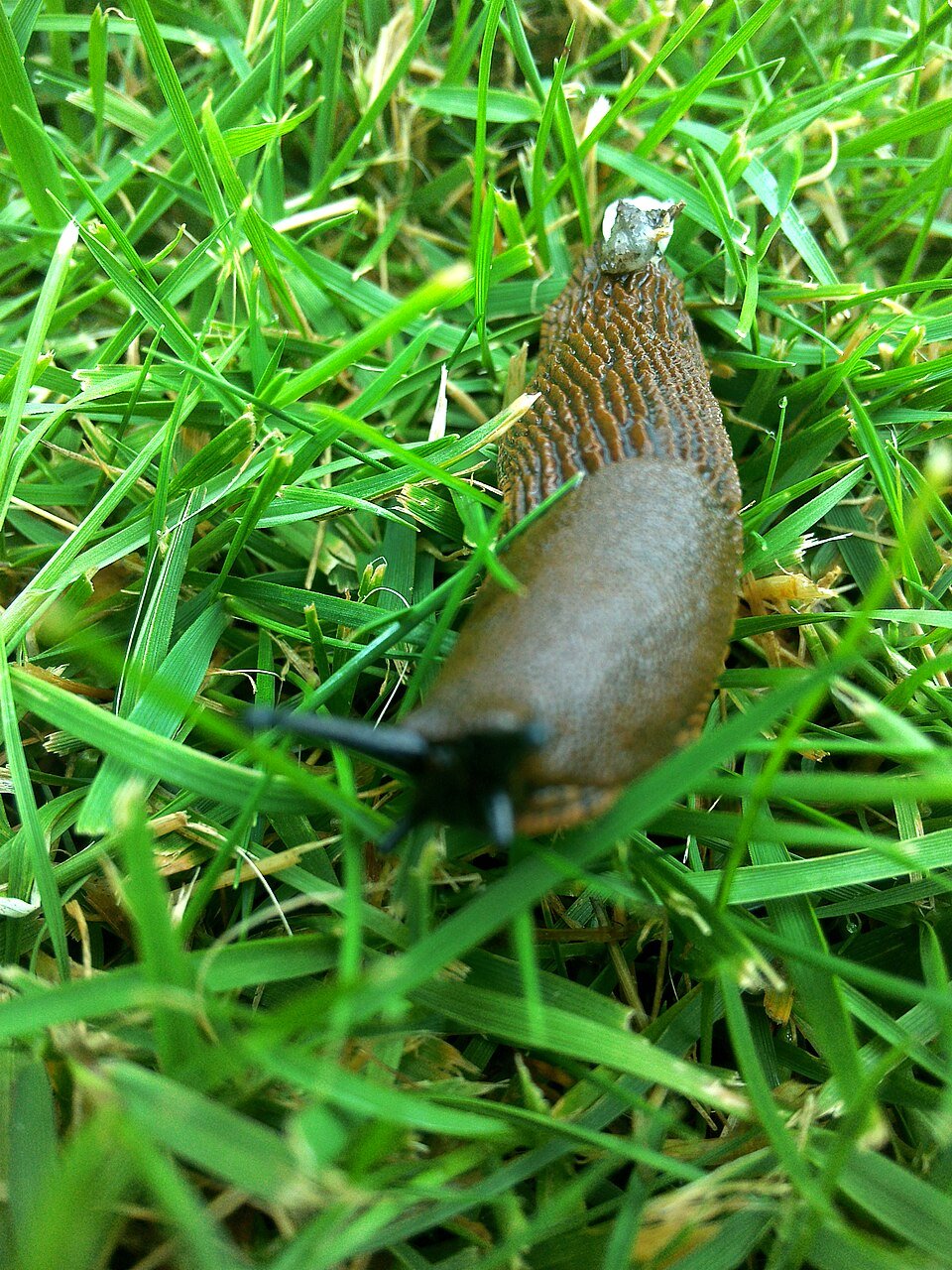
Photo: TGCGG / Wikimedia Commons · CC0.

Slugs have been and still are one of the biggest challenges in my garden. In 2026, when we had a heavy slug invasion, I used Agrosan B and Sluxx HP, and in my garden I saw better results with Agrosan B. That’s a personal observation, not a controlled comparison or a universal recommendation. For any future use, what matters is the exact product, its current label and the safety of the animals in the yard.
What you don’t see
Some snails and slugs hide in the soil, under stones, boards or dense vegetation. Eggs can stay in damp, sheltered spots. The number of generations, egg-laying period and behavior differ between species and depend on the weather.
That’s why acting against the active ones doesn’t wipe out the whole population. Others can emerge from hiding places, from eggs or from neighboring areas. Damage coming back doesn’t, on its own, prove the product didn’t work.
In the mountains the pressure is even higher: high humidity, heavy dew, summers without long heat waves and mulch — yes, the very mulch I recommend for the soil — create an almost ideal habitat. It’s a trade-off worth knowing about: mulching improves my soil and cuts down my watering, but it also shelters my slugs. I don’t give up mulch; I manage it differently around vulnerable plants.
What baits can and can’t do
How well a bait works depends on the active ingredient, the formulation, whether the pellets get eaten, the weather and following the label. I wouldn’t explain every failure by rain alone or by supposed resistance in the slugs.
Moisture can affect some pellets, but rain resistance differs between products. I check the label before another application; I don’t top up after every rain and I don’t increase the dose because I still see slugs.
Iron phosphate baits can stop slugs that have eaten enough of the product from feeding, and they may die tucked away in their hiding places. Not seeing dead slugs doesn’t prove it had no effect. But I don’t promise all damage will stop on the first night. Nor should you assume every formulation is approved for organic growing: check the specific product.
With three large dogs in the yard, I treat any bait as a product that must stay out of the animals’ reach. Metaldehyde can cause serious poisoning. Iron phosphate products aren’t automatically risk-free if swallowed in large amounts. I follow the dose, the method of spreading and the access restrictions on the label, and I store the closed package in a safe place. If I suspect a dog has eaten bait, I contact the vet immediately, with the package at hand; I don’t wait for symptoms and I don’t try home treatments.
Measures that can reduce damage
I combine several measures and watch what actually changes the damage. There’s no guaranteed timeframe in which the population will drop, and no single measure that suits every garden.
I check vulnerable plants early. Spring and fall can be important times, but I don’t assume all slugs overwinter or lay eggs at the same time. I go by the activity I see and the weather, not by a fixed date on the calendar.
I leave a little space free of mulch right next to very vulnerable plants, so I can more easily see what’s happening at the base. The strip isn’t a reliable barrier against slugs, and the rest of the bed can stay mulched.
Monitoring shelters, like a board laid on the soil, can make collecting easier. I check them regularly; forgotten in the garden, they just become extra hiding places.
Checking with a flashlight after dark, especially in wet weather, can help with identifying and collecting. I wear gloves and don’t move slugs to another garden or into a natural habitat.
When possible, I water in the morning and at the base of the plants. That way I avoid keeping the surface wet all night for no reason, without letting the plants go thirsty.
I keep spots for helpful wildlife, including ground beetles, amphibians and birds. A refuge in a quiet corner can help, but predators don’t guarantee control of an invasion. Dogs can hurt hedgehogs, so I keep an eye on them when I know there are hedgehogs in the yard.
I also choose plants slugs like less, without considering them immune: some perennial geraniums, ferns, ornamental grasses, thyme or sage may suffer less. Hostas, dahlias, delphiniums and seedlings are often vulnerable. When I choose plants for a yard with animals, I check toxicity separately; slugs avoiding a plant doesn’t mean it’s safe for dogs.
I don’t rely on eggshells, ash or copper as reliable protection. Folk barriers are unreliable, and ash can change the soil. Beer traps can catch slugs, but they don’t protect a bed on their own and need checking to avoid trapping other creatures.
Rose black spot
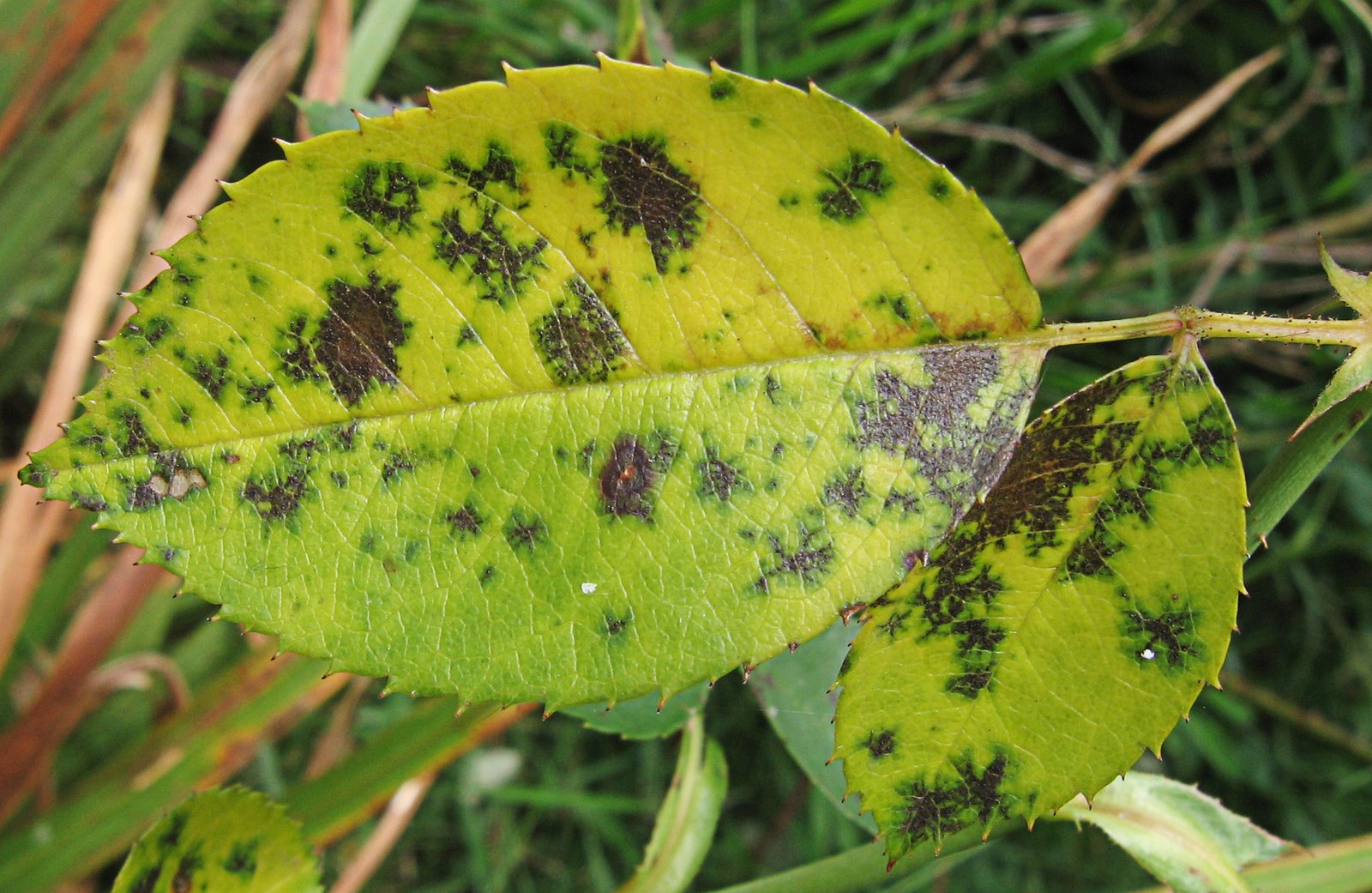
Photo: LiquidGhoul / Wikimedia Commons · public domain.

Black spot can become a serious problem in wet spells, especially on susceptible varieties.
How to recognize it
Black or purple spots appear on the leaves, sometimes with irregular edges, followed by yellowing and leaf drop. The look varies. The attack is often visible on the lower leaves, but it doesn’t necessarily start there and can’t be identified just by where the spots are.
Severe, repeated leaf loss reduces the bush’s vigor. It can affect blooming and readiness for winter, without meaning every diseased plant will be lost.
Favorable conditions
Infection is favored by persistent wetness on the leaves. How fast it develops depends on the temperature and the plant’s susceptibility, so I can’t date an infection precisely from the day I see the spots. Tissue already affected doesn’t become healthy again by spraying.
The pathogen can overwinter on fallen leaves and in infected plant tissue. Rain can help spread it.
What helps
I gather diseased leaves and remove affected sections of shoots. I don’t put infected debris in cold compost. Hygiene reduces the local source, without preventing all infections coming from nearby.
I keep suitable spacing and open up the bush with pruning suited to the type of rose. The foliage can dry faster after rain.
I prefer watering at the base, in the morning, to limit how long the leaves stay wet.
Clean mulch can limit soil particles splashing up, but it doesn’t replace removing diseased debris.
I avoid overfeeding, especially with nitrogen, and take into account the plant’s needs and the soil.
For new plantings I look for varieties with good disease resistance. Even resistant varieties can get sick, and how they behave can vary over time and from place to place.
If an attack justifies treatment, I choose only a product authorized in Romania (or wherever you garden) for that use and follow the label. I don’t recommend automatic spraying every ten to fourteen days or after every rain: intervals, the maximum number of applications and conditions of use are specific to the product. A list of active ingredients isn’t enough to make the right choice.
Powdery mildew
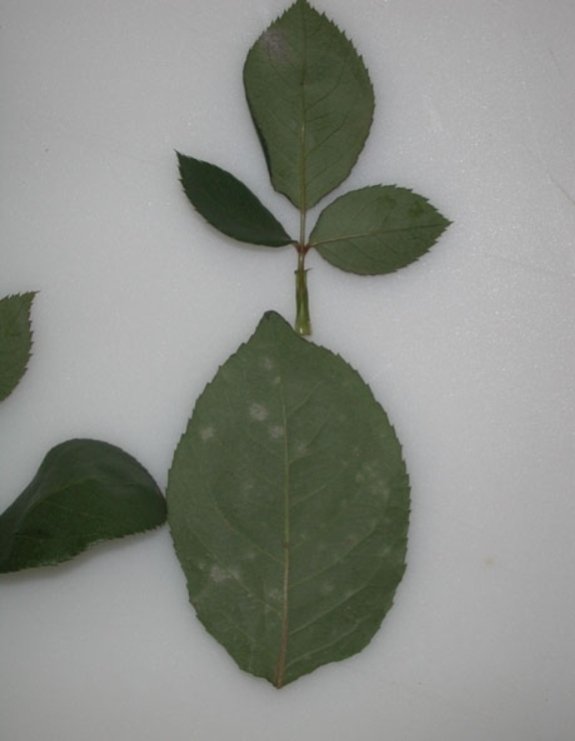
Photo: Cesar Calderon, USDA APHIS PPQ, Bugwood.org / Wikimedia Commons · CC BY 3.0.

Powdery mildew can appear even without frequent rain. Air humidity, temperature, the variety’s susceptibility and the plant’s condition all matter; it isn’t inevitable just because the garden is in the mountains.
How to recognize it
A whitish, powdery, flour-like coating on young leaves, shoots and buds. Leaves hit early curl, become distorted and stay small. Powdery mildew mainly attacks young growth, not the old leaves at the base.
Air humidity and plant stress
Unlike black spot, rose powdery mildew doesn’t need a film of water on the leaf to infect. Humid air and favorable temperature periods can support it even when it isn’t raining.
I don’t use repeated wetting of the leaves as a general solution, because it can encourage other diseases. I prefer good air circulation and proper watering of the soil.
The second factor, often overlooked: water stress. A plant with dry roots, especially one planted next to a wall or in stony soil that dries out fast, is significantly more susceptible to powdery mildew. Sometimes the solution isn’t a fungicide but proper watering and mulching.
What helps
I start by reducing water stress, with suitable spacing and choosing less susceptible varieties. If a sulfur-based product is needed, I check its authorization for the plant and disease in question. I respect the temperature limits and the intervals from oil-based products stated on the label; otherwise there’s a risk of burning.
Potassium bicarbonate products can have uses against powdery mildew, but not every formulation is authorized for every plant. I don’t replace them with improvised kitchen recipes, and I don’t consider them harmless.
When I use fungicides, I follow the strategy of alternating modes of action and the maximum number of applications. Switching brands doesn’t necessarily mean switching modes of action.
I remove heavily affected shoots as soon as I notice them, to reduce the source of spores.
I keep planting distances and open up the bush with suitable pruning.
Gray mold
Botrytis cinerea can affect flowers, buds and other tissues, especially in wet conditions. Aging or wounded tissue can help the disease take hold, but it isn’t the only tissue that can be attacked.
How to recognize it
Brown spots can appear on petals, buds can rot and a gray fuzz can form on affected tissue. But a bud that doesn’t open doesn’t, on its own, confirm Botrytis: in cold, wet weather, the outer petals can stick together and stop it from opening, a phenomenon called “balling.” This can happen without an initial infection, even if the damaged tissue is colonized later.
Persistent wetness and damaged tissue favor the disease. Plant debris can keep sources of infection going, but there’s no simple threshold of a few hours that reliably predicts an attack in every garden.
What helps
Hygiene and limiting persistent wetness are the first measures:
I remove rotting flowers and buds, as well as diseased petals stuck to the leaves. Not every spent flower is infected, but damaged tissue is worth watching after rain.
I make clean cuts with sharp tools, preferably in dry weather. I clean and disinfect the tools when I move from diseased tissue to healthy plants.
I remove dead wood and mummified buds, which can keep sources of infection for the following year.
I keep space between plants and open up the bushes.
I avoid too much nitrogen and don’t water over the flowers in the evening.
If treatment is justified, the diagnosis and an authorized product matter. The risk of resistance means following the label and the modes of action. Biological products aren’t chosen just because the plant is in bloom either; I check the permitted use and the measures for pollinators.
Rose downy mildew and misdiagnosis
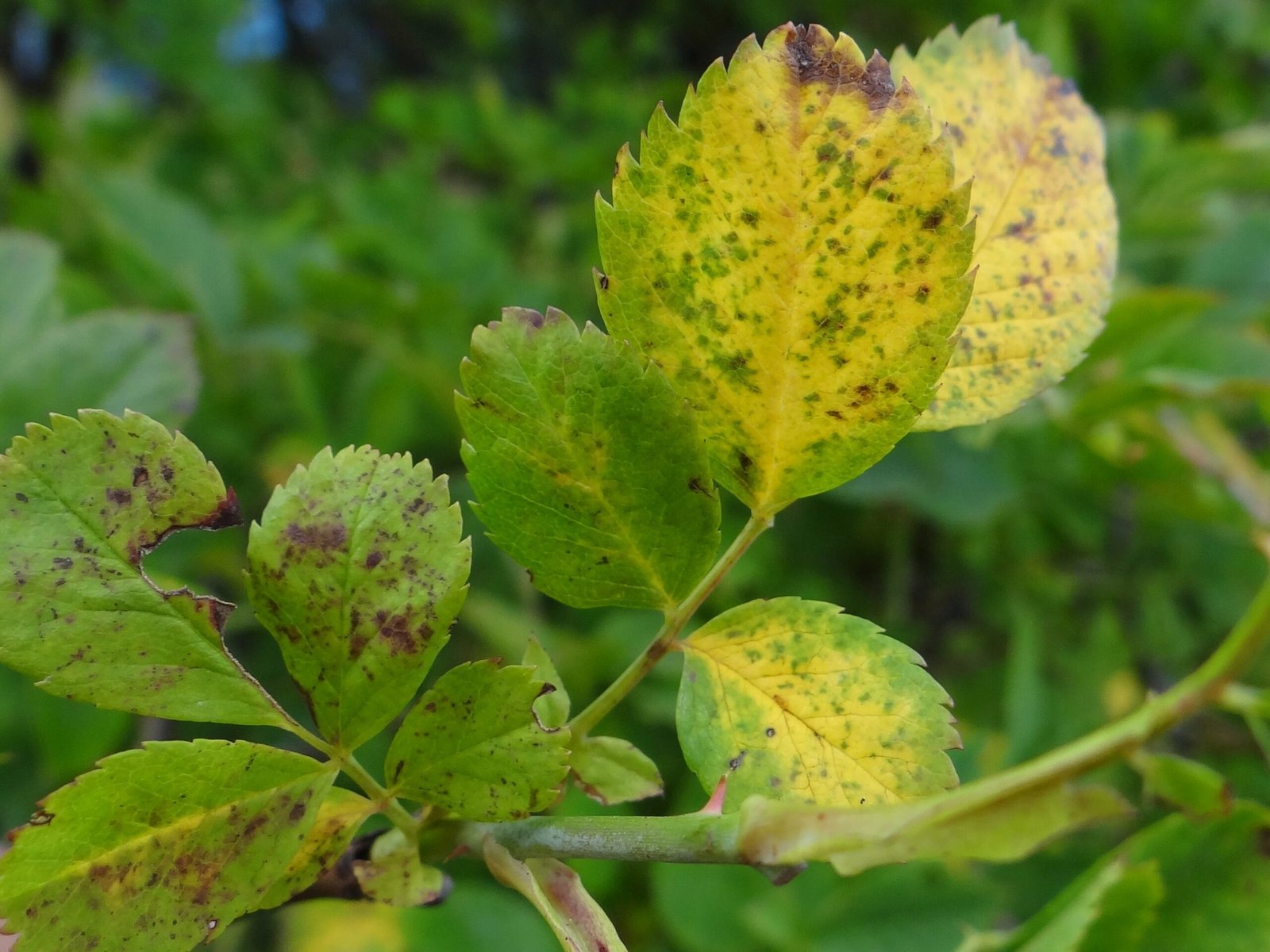
Photo: Jerzy Opioła / Wikimedia Commons · CC BY-SA 4.0.

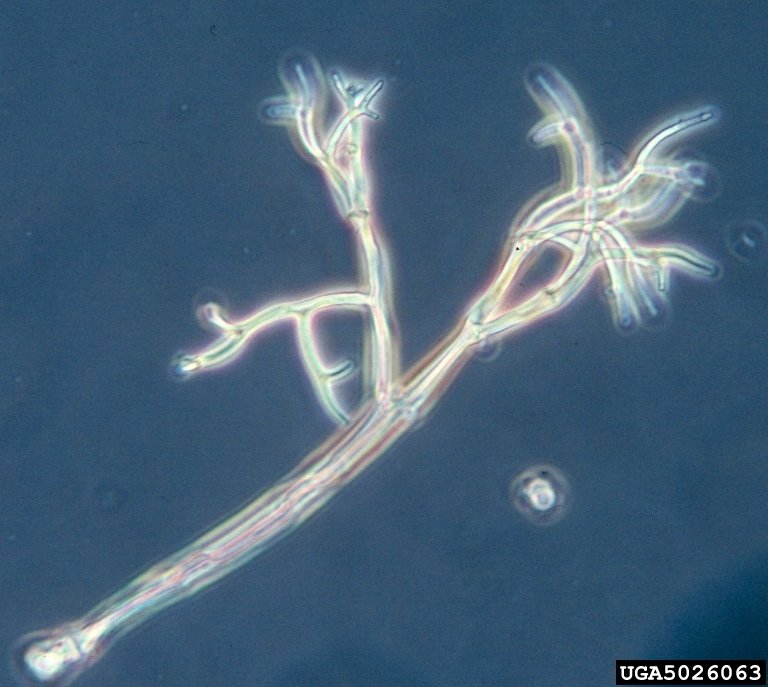
Photo: Jody Fetzer, Maryland National Capital Park and Planning Commission, Bugwood.org / Wikimedia Commons · CC BY 3.0 US.

Downy mildew is worth knowing because it can be confused with other leaf spots. But not every treatment that fails proves it’s present.
Rose downy mildew, caused by Peronospora sparsa, can cause purple or reddish-brown spots, sometimes angular and bounded by the veins. Fine, hard-to-see sporulation can appear on the undersides of the leaves, and leaf drop can be rapid. For an uncertain diagnosis or a severe attack, I ask a specialist for help and send photos of both sides of the leaf and of the whole plant.
Cool, very wet weather favors this disease. Risk periods depend on local conditions, not just the season.
The pathogen is a water mold (oomycete), different from the fungi that cause powdery mildew and black spot. A product that works against one of these diseases isn’t automatically suitable for downy mildew. I avoid general lists of active ingredients and trial and error; I check the diagnosis and whether there’s an authorized use for the specific product.
An observation calendar adapted to the weather
During dormancy I check for dead wood, mummified buds and diseased debris. I don’t turn copper treatment into a yearly obligation for every plant; whether and when it’s needed depends on the problem and the product label.
In spring I watch the new growth and slug damage. I act based on the activity I see, the history of attacks and local recommendations, not just because the growing season is starting.
In summer I check the plants weekly, and more often after spells that favor disease. I look at the undersides of the leaves too, adjust watering and remove rotting tissue. Treatments, if needed, follow the label, not a fixed interval for the whole garden.
In fall I gather diseased debris and watch for slugs in wet spells. I avoid feeding that needlessly encourages late growth; I don’t apply the same ban to every plant and product.
All year: note what you applied and when. A simple notebook shows you, after two years, what really worked and helps you avoid repeating the same substance too often.
Rules for using treatments responsibly
- I check the diagnosis before treating. Some products are preventive or can limit early infections, but they don’t restore destroyed tissue. Prevention doesn’t mean routinely spraying every healthy plant. If the problem persists, I don’t increase the dose or switch products at random. I revisit the diagnosis and ask a specialist for advice.
- I take modes of action into account, including FRAC codes for fungicides, not just the product name. I follow the permitted alternation and the maximum number of applications; two different substances can belong to the same group.
- Dose and coverage both matter. I apply exactly as the label says, without overdosing, excessive runoff or unplanned mixtures. I check the exact product in the current information from Romania’s National Phytosanitary Authority (or the equivalent authority where you live) and on the label: the plant, the target organism, the user category and the restrictions. A substance being allowed somewhere, or a product sold online, doesn’t authorize every use in my garden.
- I use the protective equipment the label calls for. I protect children, animals and nearby water, and I respect the re-entry conditions for the treated area. I store products in their original packaging and handle leftovers and packaging according to the instructions.
- I choose a weather window that suits the label, with no wind to carry the spray off target and no rain before the time the product needs. I respect the restrictions for bees and plants in bloom. Evening isn’t automatically the right time for every product or condition.
What matters in the long run
After years of trial and error, I pay more and more attention to choosing plants, where I put them and how I care for them. Treatments can be a support, but they don’t make up for all the problems of an unsuitable spot.
When a variety gets sick again and again, it’s worth asking whether it suits my garden. When replacing it, I look for good resistance and watch how the plant behaves in local conditions.
With slugs I keep a realistic goal: to reduce losses, especially on seedlings and young plants. Rainy years can still bring heavy attacks. I note what worked and what didn’t, without turning one season’s result into a promise for the next.
What problems keep coming back in your garden?
What problem comes back for you year after year — slugs, a disease or a pest you can’t identify? What have you tried that worked? Tell me in the comments.