
Plants · Roses · My garden in Bran
Munstead Wood
Purple velvet and an old-rose fragrance
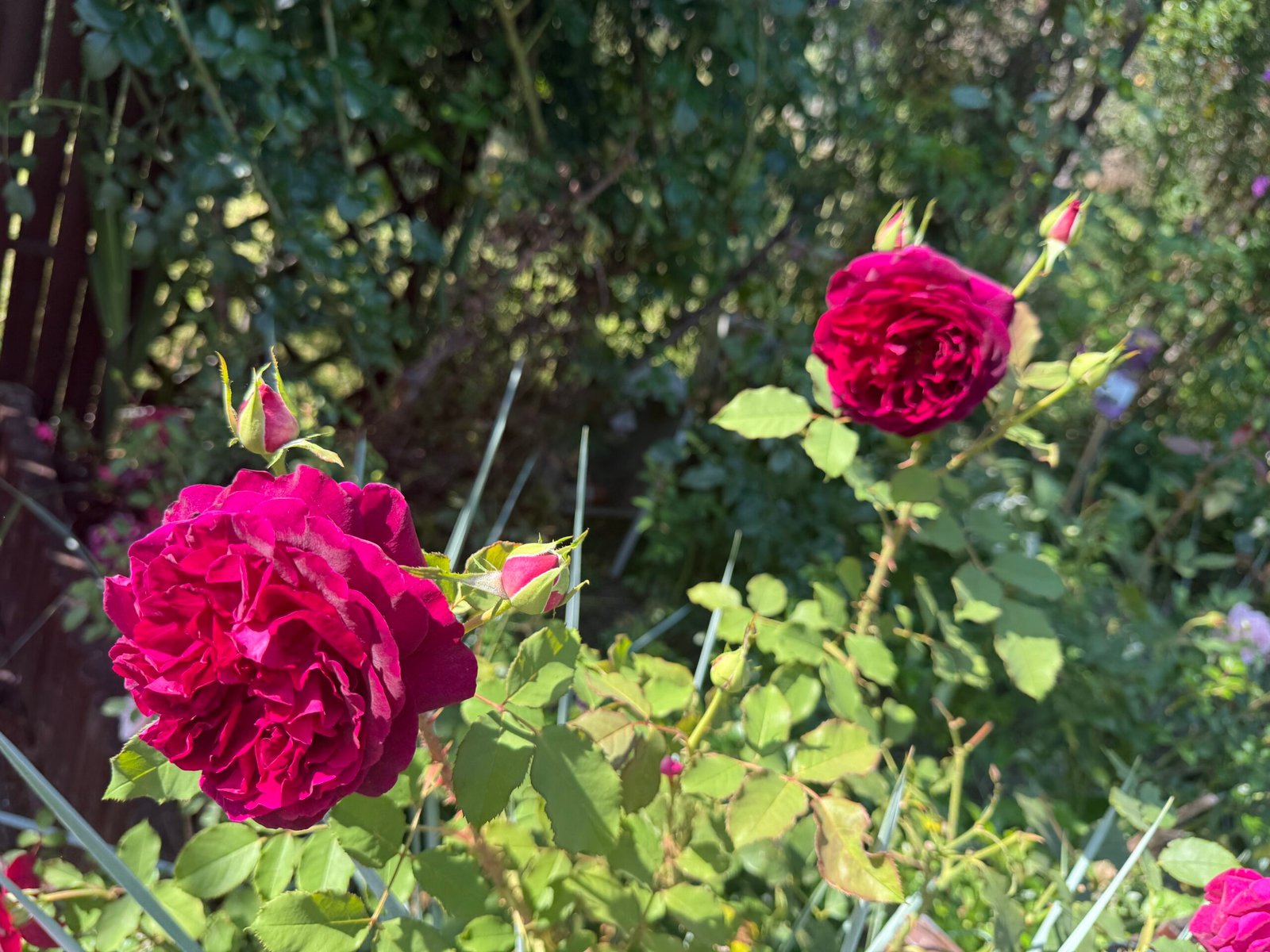
Some flowers catch your eye from a distance; others draw you closer. Munstead Wood does both. Between its petals, the red deepens toward burgundy, and the fragrance is why I stop by the bush every single time. After five years in my garden, it’s still one of my favorite roses.
A name with a garden in it
Its name isn’t a coincidence. Munstead Wood was Gertrude Jekyll’s home in Surrey, built by her friend, the architect Edwin Lutyens. That’s where Jekyll wrote her books on gardens. She first trained as a painter and designed gardens by color, like paintings. David Austin had already given her name to another rose in 1986; with this one, he named the garden itself. It feels right for a rose I look at, above all, through its color.
Variety identity
| Trade name | Munstead Wood |
|---|---|
| Cultivar name | Rosa ‘Ausbernard’, the name in the CPVO register |
| Breeder · country | David Austin · United Kingdom |
| Year introduced | 2007 |
| Class | David Austin English rose, shrub type |
| Named after | Munstead Wood, Gertrude Jekyll’s house and garden in Surrey |
The identity and general characteristics are taken from the breeder’s description and from the CPVO registration for ‘Ausbernard’.
What the breeder says and what I see in Bran
The variety name is just the starting point; the years in my garden add the rest of the story. In the table, the breeder’s description sits next to what I’ve seen on my own bush.
| Characteristic | Breeder’s description | In my garden |
|---|---|---|
| Color and form | Deep, velvety crimson, with paler outer petals. Large cups that gradually open into flatter and flatter cups. | Intense red, burgundy and purple, different in every light. |
| Flower size | Medium flowers, 5–9 cm (2–3.5 in). | Large flowers |
| Size | About 110 × 110 cm (3.5 × 3.5 ft), on a plant established for three years. | About 100 × 100 cm (3.3 × 3.3 ft), estimated. |
| Exposure | Full sun. | Direct sun until midday, then the shade of the house until sunset. |
| Bloom | Repeat flowering, in flushes, from late spring until nearly winter. | 2–3 flushes; the flowers last a long time on the bush. |
| Fragrance | Strong old-rose fragrance with notes of blackberry, blueberry and plum. | Very intense. |
| Disease | Less disease-resistant than the breeder’s newer varieties. | Very good, over five years. |
| Rain | Not stated. | The flowers hold up very well. |
| Overwintering | Not stated. | It has come through the winters well, even without hilling up, as an established bush. |
Breeder’s description: David Austin. The “In my garden” column describes a single bush in Bran, at about 770 m (2,500 ft), watched for about five years.
Two differences are worth watching. For me it does very well without sun all day, and it has proven very healthy, even though the breeder describes it as less disease-resistant than his newer varieties.
My plant: where it came from and what kind of plant it is
| Bought from | Nursery |
|---|---|
| Form at purchase | Potted |
| Type of plant | Grafted |
| In my garden | For about five years |
How it feels in the garden among the mountains
Morning sun, afternoon shade from the house
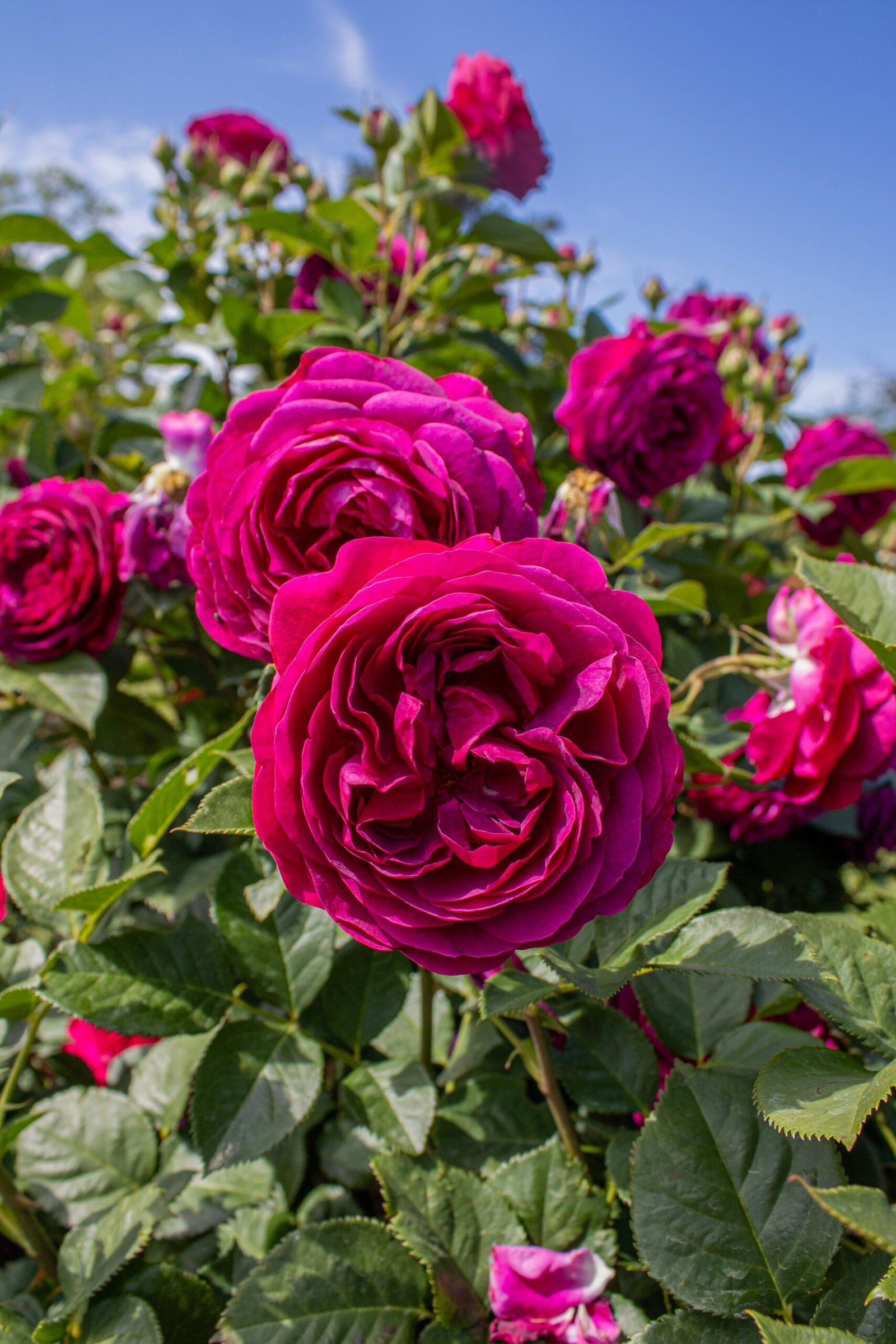
Munstead Wood gets direct sun in the morning, until around noon. In the afternoon it falls into the shade of the house and stays in part shade until sunset. In this spot, over about five years, the bush has grown beautifully and reached about a meter (3 ft) tall and just as wide.
The breeder recommends full sun, and my garden gives it only half a day. Maybe that’s exactly what suits it: the morning sun quickly dries the dew off the leaves, and the afternoon shade protects the dark petals from scorching heat. Half a day of sun isn’t the same as a corner shaded all day, but this bush has taught me to look at a plant’s actual spot, not just its label.
Two or three repeats, not a single promise
It blooms in two or three flushes. The joy of the first bloom isn’t the last: the bush comes back with new flowers, and the flowers last a long time on the stems. I haven’t timed them, but every time I notice the same two things: how long they last and how strongly they smell.
Beautiful even after rain
In a mountain garden, a flower isn’t tested by the sun alone. A summer rain can ruin a whole rose in a few hours, with petals stuck together and buds that never open. Munstead Wood pleasantly surprised me: for me, its flowers come through rain very well. It’s one of the reasons I value it, beyond its color and fragrance.
A rose I can count on in winter
In my garden it has proven very cold-hardy. It got through without trouble even in winters when I forgot to hill it up, but it was already a well-established bush; I wouldn’t deny protection to a plant just put in the ground. Its health has pleased me too: over these years it has proven very disease-resistant.
Pruning
I prune it in spring, and never hard. I only remove the parts damaged by frost and let the bush keep its shape. I’ve written in detail about when and how to prune in the guide to pruning roses.
Companions: purple, violet and silver foliage
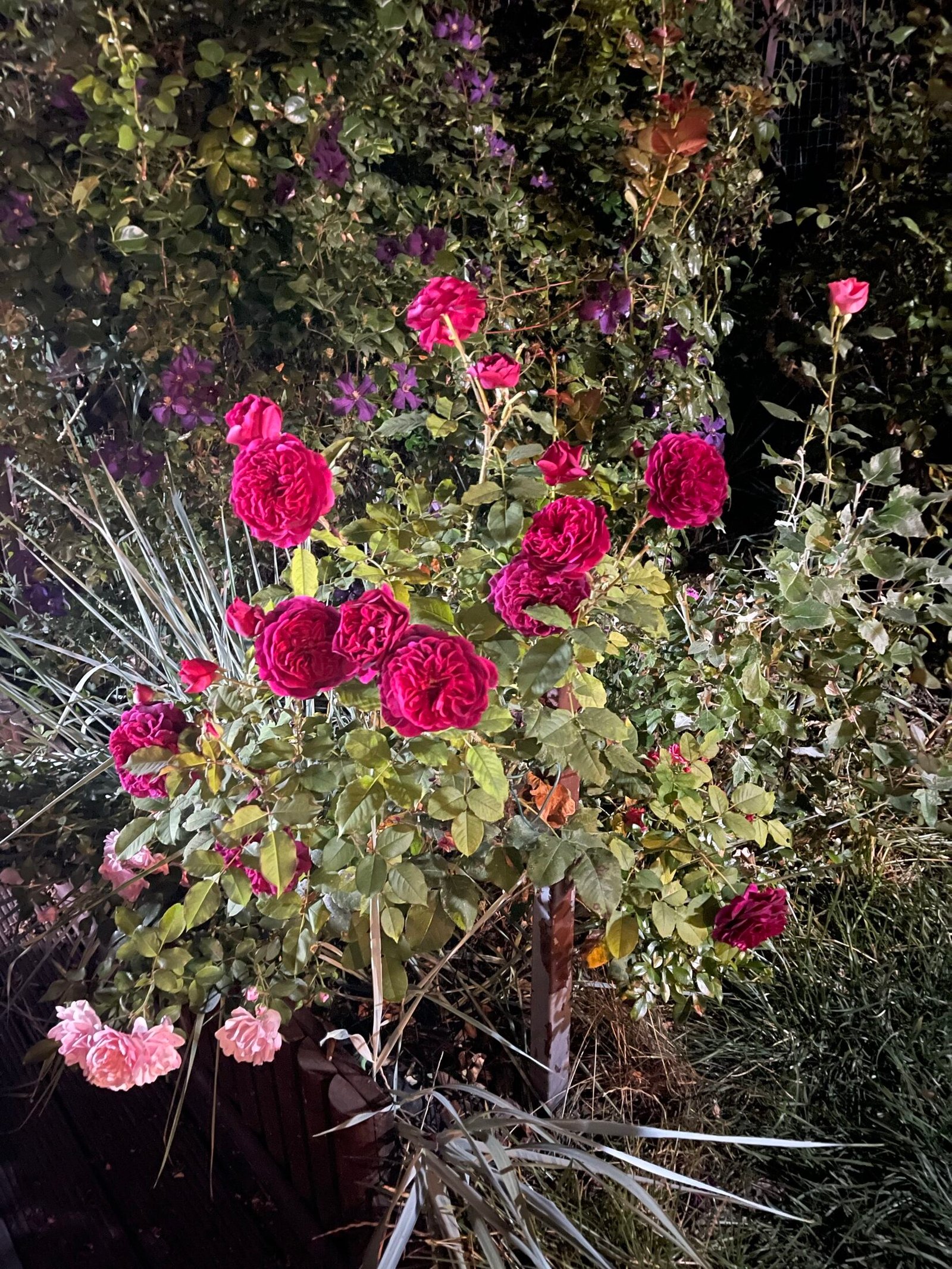
I also love seeing it alongside the plants around it. Next to violet clematis flowers, its purple gains depth, while pale pink and silver foliage bring a gentler contrast. Perhaps the name demands it.
Pointers for another garden
If you want to try it, I’d start with what all roses need: enough light, fertile, well-drained soil, air moving between the bushes and enough water in dry spells. For me, half a day of direct sun was enough. And cold hardiness is no substitute for good drainage.
For a plant just put in the ground or for a very exposed spot, winter protection is worth thinking about separately.
Read alongside this profile
Legal status: plant variety protection
In short: the register cited in this profile shows the variety protected in the EU until December 31, 2039. The registration details are below; for the current status, check the official CPVO file.
Protected in the European Union. Checked in the CPVO register: September 22, 2026.
| Register · status | CPVO · “Granted”; “Title status: Approved” |
|---|---|
| Title number · application | 24573 · 20072406 |
| Date granted | April 6, 2009 |
| Expiry | December 31, 2039, according to the register |
Why 2039: for ornamental shrubs, and therefore for roses, protection lasts 30 years, not 25. The extension comes from Regulation (EU) 2021/1873 and also applies to titles granted earlier.
Why it stays among my favorites
Not just for its spectacular color, and not just for its fragrance. I value it because all of this comes together with a bush that, for me, grows well, blooms generously and gets through winters without trouble.
In a garden where the weather often changes your plans, a beautiful rose you can count on becomes, over time, more than just a variety in a collection.
Do you grow Munstead Wood too? How does it handle rain and winter for you? Tell me in the comments.
What I still want to track
This profile stays open. In my next observations I’ll record the measured height and width, not just estimates, the months of the first and last bloom, how long a flower lasts on the bush and how the leaves behave in a wet season. I’ll measure flower size and petal count rather than estimate them. I haven’t tried it in a spot with sun all day.
Sources and observations
Personal experience: Julia, my garden in Bran, at about 770 m (2,500 ft) above sea level. Profile written in September 2026, after about five years of growing it.
- Variety identity and characteristics: David Austin — Munstead Wood and Royal Horticultural Society — Rosa Munstead Wood (‘Ausbernard’)
- Variety status: CPVO — file 20072406, title 24573
- Duration of protection: CPVO — extension of protection from 25 to 30 years
- Exceptions to protection: CPVO — Notes for applicants, section 15