
Practical guides · Pruning by plant type
Pruning clematis
First I find out which stems will carry the flowers
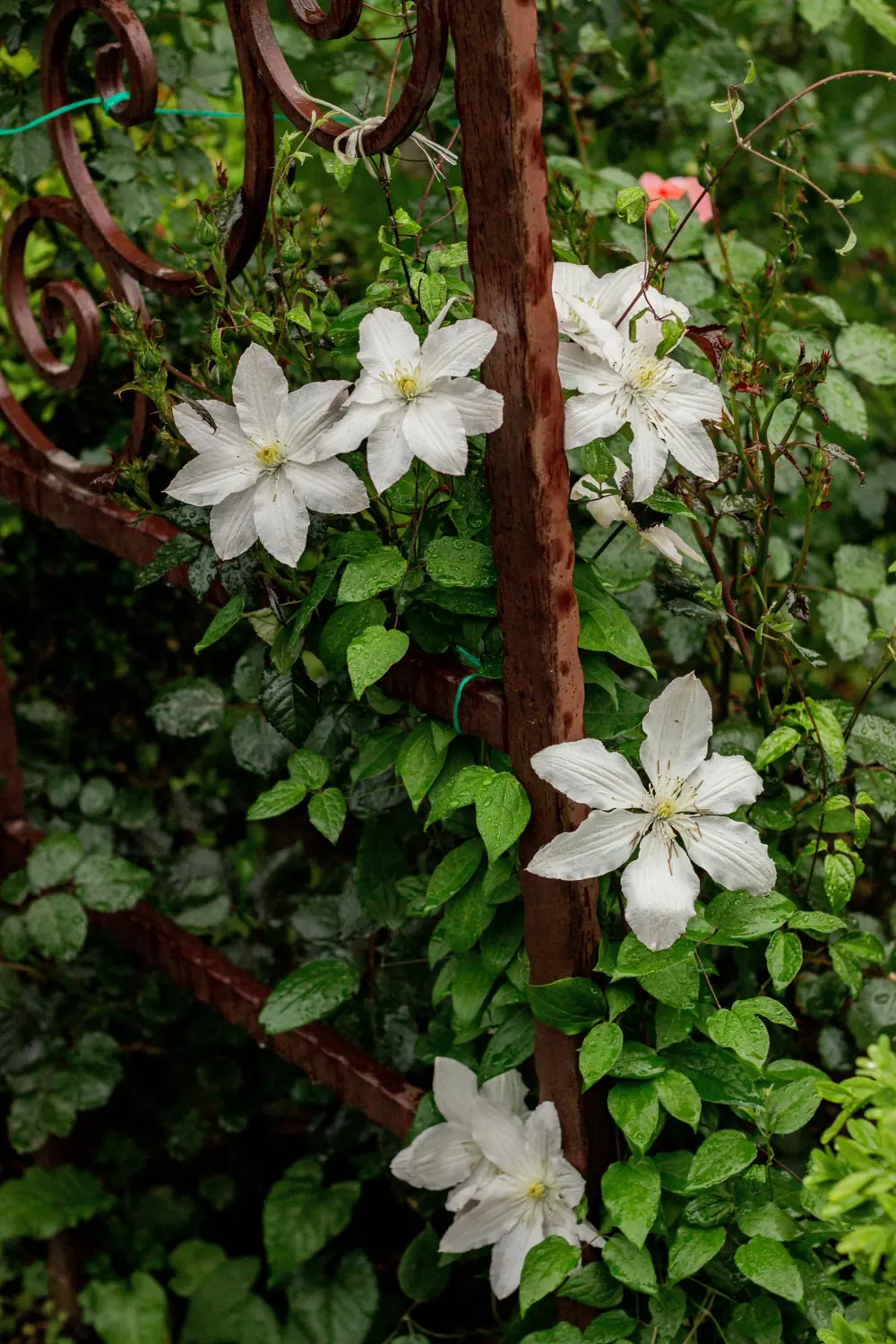
Clematis can turn even a simple support into a cascade of flowers, but their tangled stems often make pruning feel complicated. Before I untangle any knot of stems, I first find out which stems the flowers will come from.
For pruning, clematis are divided into three groups. The group tells you which growth the plant flowers on, not how hardy it is or what color the flower is. In the mountains, flowers can appear later than catalogs suggest. [1]
At a glance
Early flowering
Group 1
Flowers early, on last year’s growth; I prune lightly, after flowering [1], [2]
Large flowers
Group 2
First flush on last year’s wood; I prune lightly in late winter and after the first flush [1], [3]
New growth
Group 3
Flowers from summer, on new growth; in late winter I cut back to the lowest pair of healthy buds [1], [4]
To identify
No label
If it flowers before early June, I don’t prune it in spring; if it flowers from late June on, I prune it in late winter [1]
Avoid
What I don’t do
I don’t pull out dead stems; I cut them out in pieces
A rough calendar for Bran
The timing is estimated for an altitude of 770 m (2,500 ft) and can shift by a week or two, depending on the year.
Rough timing for pruning clematis in the garden in Bran, Brașov County
| Task | Jan | Feb | Mar | Apr | May | Jun | Jul | Aug | Sep | Oct | Nov | Dec |
|---|---|---|---|---|---|---|---|---|---|---|---|---|
| Group 1 | ● | ● | ||||||||||
| Group 2: cleanup | ● | |||||||||||
| Group 2: after the first flush | ● | ● | ||||||||||
| Group 3 | ● | |||||||||||
| Herbaceous clematis | ● | ● |
The groups at a glance
Group 1
C. alpina, C. macropetala, C. montana
Group 2
‘Nelly Moser’, ‘The President’
Group 3
‘Jackmanii’, ‘Perle d’Azur’, C. viticella
Herbaceous
C. integrifolia, C. heracleifolia, C. recta
When and how much I prune
In late fall or early spring, close to the ground. [1]
Group 1 keeps last year’s growth
This group includes clematis that flower early, on last year’s growth, like many forms of Clematis alpina and Clematis montana. They usually don’t need pruning every year. If they need to be kept in check, I prune them after flowering: I remove or shorten the stems that grow out of their space. [2]
Hard pruning before flowering would remove the very growth that carries the flowers. I rejuvenate a very old plant separately, knowing I’ll lose the next year’s flowers. [1]
Group 2 needs a light hand
This group includes many large-flowered varieties, which produce a first flush on shoots from the old stems and sometimes a second one on new growth. Not every large-flowered clematis belongs to group 2, though. [3]
Toward the end of winter I remove dead or weak stems. I check the healthy ones from the top down and shorten them above a strong pair of buds, keeping as much of them as possible. After the first flush, lightly cutting back the spent flowers can bring a second flush, depending on the variety and the weather. [3]
Group 3 starts on new growth
Clematis in this group flower later, on this year’s growth. Toward the end of winter I cut the stems above the lowest pair of healthy buds, usually about 30 cm (1 ft) from the ground. They don’t all have to be the same height. [4]
Pruning keeps the flowers at eye level and the base of the plant clothed. Left unpruned for years, these clematis get tangled, and the flowers climb higher and higher above bare stems. Pruning late, after many shoots have started, does delay flowering, though. [1]
I work without pulling on the plant
Dead stems often stay caught on the support or on neighboring stems. I cut them out in pieces instead of pulling them out in one go and breaking live buds or shoots. After cleaning up, I lay the stems I’m keeping on the support, without tight ties.
When I don’t know the group
The first option is the label or the variety name. If they’re missing, I prune as little as possible, watch where and when the flowers appear and take notes. I don’t decide the group just from a photo of the flower or from the bloom date, which fickle weather can shift. [1]
The rules above are for mature, well-established plants. A very young clematis with one or two stems may need formative pruning at planting, even if that delays the first flowers. [3], [4]
A tip from French gardens
The French say clematis wants its “head in the sun and feet in the shade.” I cover the base with low plants, a thick layer of mulch or a few stones, so the roots stay cool. [5]
Step by step
- I look for the label or the variety name and find the group.
- I remove the dead stems, cutting them out in pieces.
- I prune by group, above a pair of healthy buds.
- I lay the stems I’m keeping on the support, without tying them tightly.
- I mulch the base.
Common mistakes and what I do
Diagnosis
Flowers only at the top, bare stems below
Likely cause
Group 3 left unpruned for years [1]
What I do
I prune it in late winter, down to the lowest pair of buds.
Diagnosis
No flowers in spring
Likely cause
Group 1 pruned before flowering [2]
What I do
I prune it only after flowering.
Diagnosis
Few flowers on a large-flowered variety
Likely cause
Group 2 cut back too far [3]
What I do
I only shorten the dead tips.
Diagnosis
Stems that suddenly wilt and turn black
Likely cause
Clematis wilt [5]
What I do
I quickly cut out the affected stems and remove them from the garden; I keep the soil well drained.
Diagnosis
Shoots broken after cleanup
Likely cause
Dead stems pulled out
What I do
I cut them out in pieces.
Tools and hygiene
Pruners should be sharp and clean: a clean cut closes faster than a crushed one. For thick stems I use loppers or a saw and don’t force small pruners.
When I cut diseased stems, I wipe the blade with 70% alcohol before moving on to the next plant, so I don’t spread the disease. At the end I clean my tools, dry them and oil them lightly so they don’t rust. [6]
What I do with the clippings
I chop healthy stems and add them to the compost. Stems that wilted suddenly or are diseased go out of the garden. [5]
In my garden
With clematis whose group I don’t know, I follow a simple rule: I watch how they flower for a season and only then prune them.
In the garden
Clematis montana
Group
Group 1 (flowers on old wood)
Flowers in Bran
Late spring (May–June)
In the garden
‘The President’
Group
Group 2 (flowers on old and new wood)
Flowers in Bran
Late spring and early summer (May–June), then again toward late summer
In the garden
‘Hagley Hybrid’
Group
Group 3 (flowers on new growth)
Flowers in Bran
Summer (June–July)
In the garden
‘Etoile Violette’
Group
Group 3 (flowers on new growth)
Flowers in Bran
Summer (July–September)
Checklist
- I know the group of each clematis.
- Group 1 stays unpruned until after flowering.
- Group 2: I removed only the dead tips.
- Group 3: I cut low, above healthy buds.
- I cut out dead stems in pieces.
- The base of the plant is shaded and mulched.
Further reading
- RHS — Clematis: pruning
- RHS — Clematis pruning: group one
- RHS — Clematis pruning: group two
- RHS — Clematis pruning: group three
- Jardiner Malin — Clematis (in French)
- Jardiner Malin — Caring for garden tools (in French)
I’ve adapted the advice from these sources to my mountain garden. The weather, the plant and its condition matter more than the month on the calendar.